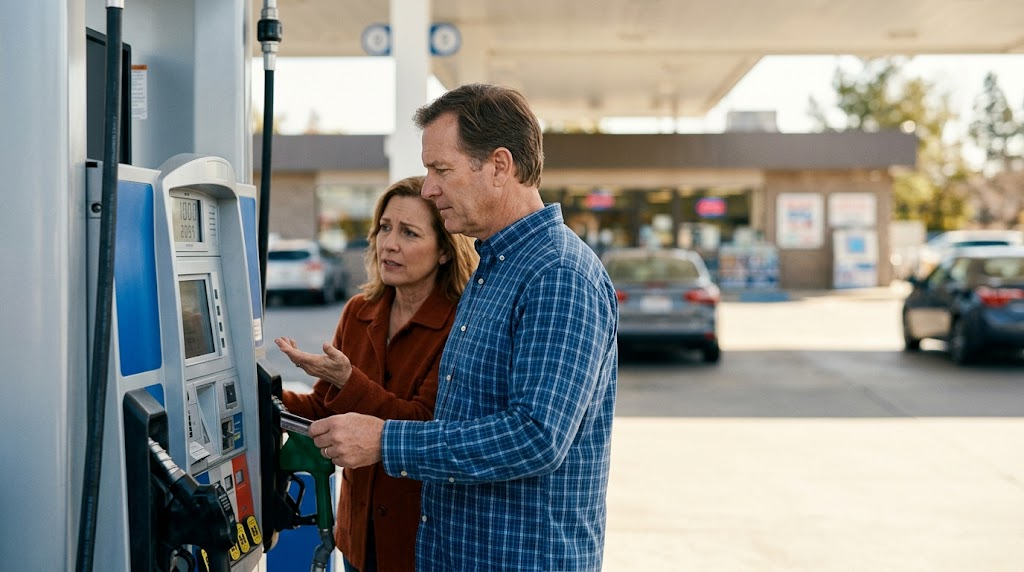
It is a common sight at the pump: one price in big, bright numbers for cash and another, higher price for credit cards. We have all felt that slight sting of realizing the cheap gas we saw from the road is only for people carrying cash. It feels a bit like a penalty for using plastic, especially when you are trying to use Cards for building credit to improve your financial standing. But there is a logic behind it, even if that logic does not make your fill-up any cheaper.
The hidden cost of the swipe
The main reason gas stations charge you more for using a credit card is that it costs them money to take your payment. Every time you tap or swipe, the station has to pay a fee to the bank and the card network. These are often called merchant fees or swipe fees. Because gas stations usually have very thin profit margins, they do not want to eat those costs themselves. Instead, they pass them on to you. If a station pays a few percentage points on every transaction, they simply add those cents to the price per gallon for credit users.
This is different from Banking & Savings accounts where your money just sits and waits. When you use a card, a whole network of companies gets involved to move the money, and they all want a cut. For someone focused on Investing their extra cash, these small surcharges can feel like a leak in their budget that needs to be plugged. If you use Cash-back cards, you might earn enough rewards to cancel out this extra cost, but if your card does not offer rewards, you are just paying a premium for convenience.
The phantom charge: Pre-authorization holds
If you have ever checked your mobile banking app right after getting gas and seen a charge for $100 or $150 when you only bought $30 of fuel, you have seen a pre-authorization hold. This is a temporary block on your funds. The gas station does not know if you are going to fill up a tiny sedan or a massive truck, so they ask your bank to hold a large amount to make sure you can pay for whatever you pump. This is a common practice, but it can be a trap for those with lower credit limits.
When you are using cards to build your credit, your credit limit might be small. If a gas station puts a $150 hold on a card with a $300 limit, you have suddenly used up half of your available credit. This affects your credit utilization, which is a big factor in your credit score. If that hold stays on your account for a few days, it could make it look like you are maxed out, which is the last thing you want when trying to look responsible for future Mortgages or Loans. To avoid this, you can often pay inside at the attendant for a specific amount, which usually bypasses the large hold.
The real cost of carrying a balance
While the extra ten cents a gallon is annoying, it is nothing compared to the cost of interest. Every credit card comes with an annual percentage rate (APR), which is the total cost of borrowing money over a year, including interest and fees. If you do not pay your gas bill in full by the end of the month, that gas becomes much more expensive as interest starts to pile up. This is especially true for cards designed for beginners, which often have higher rates than No annual fee cards or Travel rewards cards aimed at people with high scores.
On the flip side, when you keep your money in a savings account, you look at the annual percentage yield (APY), which is the amount of interest you earn on your money in a year. You want your APY to be high and your APR to be low. If you are paying high interest on gas station charges, you are effectively negating any progress you make with your savings or other financial goals like paying for Insurance or car maintenance.
Comparing your options at the pump
When you are standing at the pump, you have a few choices to make. If the credit price is significantly higher, using a debit card might seem like a good middle ground. Some stations treat debit like cash, but others treat it like credit because they still have to pay processing fees. You have to read the fine print on the sign. If you have a business and use Business cards, the extra cost might be a simple business expense you are willing to accept for the sake of easy tracking and accounting.
If you find yourself struggling with a high balance because of gas and other daily needs, Balance transfer cards can sometimes help you move that debt to a place with a lower interest rate for a while. However, the best strategy is usually to pay with cash if the discount is large enough, or to use a card that gives you enough rewards to outweigh the surcharge. Always keep an eye on your total balance to ensure you aren't accidentally hurting your credit score with those temporary holds.
Common traps to watch for
- The debit surcharge: Do not assume debit is the same as cash; check the pump screen before you start.
- Long-lasting holds: Some holds can take up to three business days to disappear, locking up your spending money.
- Minimum spends: Some stations require you to buy a certain amount of gas to get the lower price, though this is rare.
- Interest creep: If you use a card for the convenience but cannot pay it off, the interest will quickly dwarf the few cents you might have saved by picking a different station.
At the end of the day, the gas station is just trying to cover the cost of the technology that lets you pay without walking inside. It is a convenience fee, plain and simple. By understanding how these fees work and how holds affect your credit, you can make sure you are not paying more than you have to just to get from point A to point B.