0% for 15 billing cycles on purchases, and to… Bank of America® Customized Cash Rewards Credit Card for Students Calculators How we make money
VOATLAS
How to Pay for a Car Battery Without Paying Interest

How to · Auto

How to Pay for a Car Battery Without Paying Interest

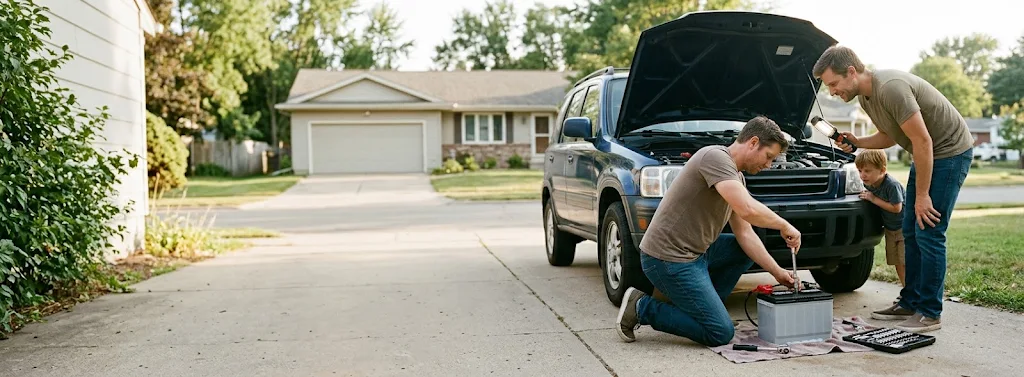
When your old battery starts turning over slow, replace it for about $200 now and split the cost over 18 months at $11.11 a month.

Typical cost $200 before anything else
Across the 0% window $11.11/mo 18 months, no interest

How we got that: $200 spread evenly across the 18-month introductory window on the Citi Simplicity® Credit Card. Checked · at the bank Carry a balance past the window and the standard APR applies to what is left.

Owning a car means paying for more than the monthly payment—gas, insurance, tires, and surprise maintenance eat into your budget all year. A typical replacement battery runs about $200, and while prices rarely drop drastically, auto parts stores tend to offer their softest pricing and rebates in spring and fall before extreme weather hits.

The best time to buy is when the old one starts turning over slow, before it leaves you stranded in a parking lot. Keep shopping for the part separate from how you pay for it—compare store quotes first, and save a 0% card window for maintenance extras like a battery rather than trying to put a whole vehicle on plastic.

That 18-month intro window is a firm deadline, not free money. If any part of the $200 battery balance is still sitting on the card when the 0% period ends, the regular interest rate kicks in on whatever is left and quickly erases your savings. Stick to the $11.11 monthly plan so the balance hits zero before month 18 arrives.

The steps

  1. 01

    Watch for a slow crank

    Pay attention when your engine hesitates on startup or turns over slower than usual. Waiting until the battery dies completely forces you to buy whatever the nearest shop or tow service has in stock. Catching it early gives you a few days to compare prices calmly.

  2. 02

    Price the battery first

    Call two or three local auto parts stores to confirm the exact size your car needs, which typically costs around $200 in the US. Ask whether installation is included in the price and how much the refundable core deposit is for handing in your old battery. Locking in the total out-the-door number before you pull out a card keeps surprise add-ons off your receipt.

  3. 03

    Use the 18-month window

    If you would rather not drain $200 from checking all at once, the Citi Simplicity® Credit Card (Citi) offers 0% for 18 months on purchases and balance transfers from date of account opening. Spreading $200 across that 18-month intro window works out to $11.11 per month without interest piling up. Approval is never guaranteed, and whether to apply is your call, so only lean on a card window if it fits your overall budget.

  4. 04

    Automate the monthly payoff

    Set up an automatic payment for $11.11 a month—or round up to $15 or $20 if you want it gone sooner—right after the charge posts. Paying only the card's minimum payment usually will not clear the full $200 before the clock runs out. Treat this like a short utility bill and avoid adding everyday gas or groceries to the same balance.

  5. 05

    Turn in your dead battery

    Bring your old battery back to the store counter as soon as the new one is installed. Most auto parts retailers hold a small refundable deposit until you return the spent unit for recycling. Getting that deposit back right away keeps your net cost close to that $200 target.

  6. 06

    Check the card terms before you commit

    Every figure we publish for the Citi Simplicity® Credit Card carries the date a person verified it against Citi and a link to where they checked. Intro windows and APRs change without notice, so confirm the current terms before applying.

    See Citi Simplicity® Credit Card terms →

Common questions

How much does a replacement car battery usually cost?

A typical replacement car battery in the US costs about $200. Exact pricing depends on your vehicle's battery group size and specs, plus whether you install it yourself or pay a shop. Always ask if the quoted price includes installation and the refundable core deposit.

When should I replace my car battery?

Buy a replacement when the old one starts turning over slow instead of waiting for a complete failure. Shopping in spring or fall can also help you catch seasonal rebates before summer heat or winter cold strains older batteries. Testing it early at an auto counter gives you time to compare deals.

Is it smart to put a $200 car repair on a 0% card?

Using a 0% intro window can make sense if an unplanned $200 bill would otherwise squeeze your checking account or emergency cash. Spreading $200 over 18 months lowers the monthly hit to $11.11 while charging zero interest during the window. It only works in your favor if you avoid adding new balances and pay it off on time.

What happens if I miss the 18-month payoff deadline?

Any balance remaining after the 18-month intro period ends starts accruing interest at the card's standard rate. You do not get an automatic extension just because the original purchase was $200. Setting up automatic monthly payments of at least $11.11 keeps you ahead of the cutoff.