0% intro APR for 15 months from account openi… Chase Freedom Flex ® Credit Card Calculators How we make money
VOATLAS
How to Pay for a Whole-House Water Softener

How to · Home

How to Pay for a Whole-House Water Softener

Hard water is ruining your fixtures. Here is how to get a system installed without tanking your cash flow.

Typical cost $2,300 before anything else
Across the 0% window $127.78/mo 18 months, no interest

How we got that: $2,300 spread evenly across the 18-month introductory window on the Citi Simplicity® Credit Card. Checked · at the bank Carry a balance past the window and the standard APR applies to what is left.

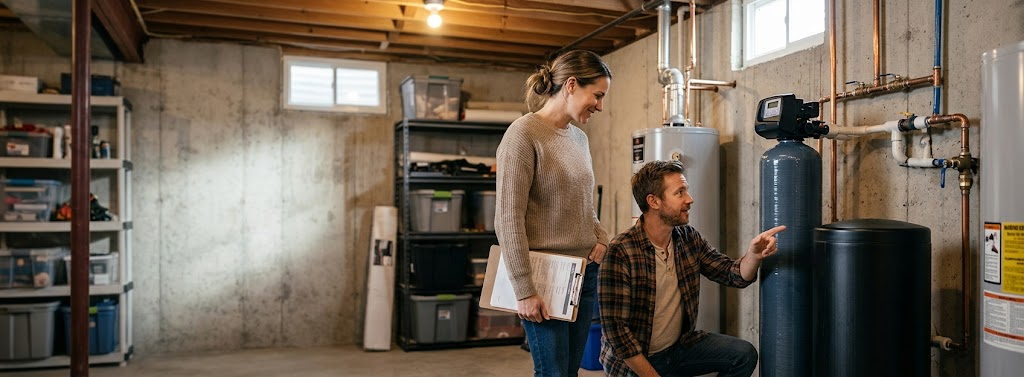
You will notice the change the first time you wash your hands. Your skin stops feeling tight, soap actually lathers, and the crusty white buildup around your faucets finally stops coming back. An installation usually takes a half-day for a plumber to cut into your main line and mount the tanks near your water heater.

Late winter is the best time to book this. Plumbing contractors are slower right now and far more flexible on their labor pricing than they are when spring remodeling season hits. Call at least three local independent plumbers for quotes before you let anyone touch your pipes.

That 18-month window is a strict deadline, not free money. If you still have a remaining balance on the Citi Simplicity® Credit Card (Citi) when those 18 months end, deferred interest rules will kick in and tack on steep finance charges retroactively, wiping out your savings.

The steps

  1. 01

    Get three competing quotes

    Call local plumbers and ask for itemized bids on both the equipment and the labor. Prices swing wildly between small shops and big franchise brands. Make sure every quote includes the bypass valve and pre-filtration stage so you are comparing exact matches.

  2. 02

    Check the installation space

    Go look at where your main water line enters the house. You need enough floor space for the mineral tank and the brine tank, plus access to a nearby power outlet and a drain for the backwash cycle. Clear that area out before the plumber arrives.

  3. 03

    Line up the Citi Simplicity® Credit Card

    We can spread the typical $2300 cost over time using the Citi Simplicity® Credit Card (Citi), which gives us 0% for 18 months on purchases and balance transfers from date of account opening. That math works out to $127.78 per month across that 18-month window. Divide the actual plumber's invoice by your months available and pay that exact chunk automatically every single month.

  4. 04

    Verify the warranty details

    Water softeners have moving parts that deal with high mineral counts daily. Ask if the manufacturer warranty covers the control valve and tanks for at least ten years. Confirm whether your plumber includes a workmanship warranty on their pipe connections.

  5. 05

    Schedule the install day

    Plan to be home for four to six hours while the main water supply is shut off. Ask the plumber to test your water hardness both before and after the system is running so you have proof it works properly.

  6. 06

    Check the card terms before you commit

    Every figure we publish for the Citi Simplicity® Credit Card carries the date a person verified it against Citi and a link to where they checked. Intro windows and APRs change without notice, so confirm the current terms before applying.

    See Citi Simplicity® Credit Card terms →

Common questions

How much does a whole-house water softener cost to install?

A standard system and professional installation typically run about $2300 total. Premium units with high-end carbon filtration or smart valves will push that number higher.

Do I need a plumber or can I DIY this?

Unless you know how to sweat copper pipes or cut PEX lines safely under pressure, hire a pro. One leak on your main water line can flood your basement before you notice.

How often do I need to add salt?

Most households need to dump a 40-pound bag of salt into the brine tank every four to six weeks. It is cheap routine maintenance that keeps the resin beads clean.

What is the difference between a water softener and a filter?

A softener specifically removes hard minerals like calcium and magnesium through ion exchange. A filter removes sediment, chlorine, or chemicals, though you can buy combination systems that do both.