0% for 15 billing cycles on purchases, and to… Bank of America® Customized Cash Rewards Credit Card for Students Calculators How we make money
VOATLAS
How to Pay for a Dual Dash Cam Setup

How to · Auto

How to Pay for a Dual Dash Cam Setup

Protect your car with a front and rear dash cam setup for $380, split into $25.33 a month without paying interest.

Typical cost $380 before anything else
Across the 0% window $25.33/mo 15 months, no interest

How we got that: $380 spread evenly across the 15-month introductory window on the Discover it® Cash Back. Checked · at the bank Carry a balance past the window and the standard APR applies to what is left.

Owning a car is a steady leak of cash between insurance, fuel, and routine maintenance. When someone clips your bumper in a parking lot or cuts you off on the commute, proving what happened should not cost you a deductible. Timing aftermarket upgrades matters just as much as buying the vehicle itself. The price on automotive tech is softest in late November during holiday sales, making it the smartest moment to grab extra safety gear.

A solid front and rear camera system with a proper hardwire kit runs about $380. That is an extra expense you do not need to drop all at once, especially if you plan your purchase window right.

The 15 months at 0% intro APR is a hard deadline, not free cash. If you still have an unpaid balance when the intro period ends, the standard variable APR kicks in on whatever is left. Set an autopay for $25.33 every month so the setup is zeroed out before month 15 arrives.

The steps

  1. 01

    Time your buy for late November

    Electronics retailers bundle cameras with hardwire kits and memory cards during Black Friday week. You can snag a quality dual-channel system for roughly $380 instead of paying full price for accessories piecemeal. Watch for bundles that include high-endurance microSD cards, which handle constant video overwrites better.

  2. 02

    Match your fuse taps early

    Hardwiring keeps your cabin clean and enables parking mode surveillance when the engine is off. Check your car's manual to find whether your fuse box uses mini, low-profile mini, micro2, or standard ATO fuses. Ordering the right fuse taps with the camera avoids a second purchase or paused installation.

  3. 03

    Finance the hardware at zero interest

    The Discover it® Cash Back gives you a 0% intro APR for 15 months on purchases and balance transfers. Charge the $380 setup to the card, split the cost into $25.33 per month, and you clear the bill across the full 15-month intro window without paying interest fees.

  4. 04

    Run the wires along the trim

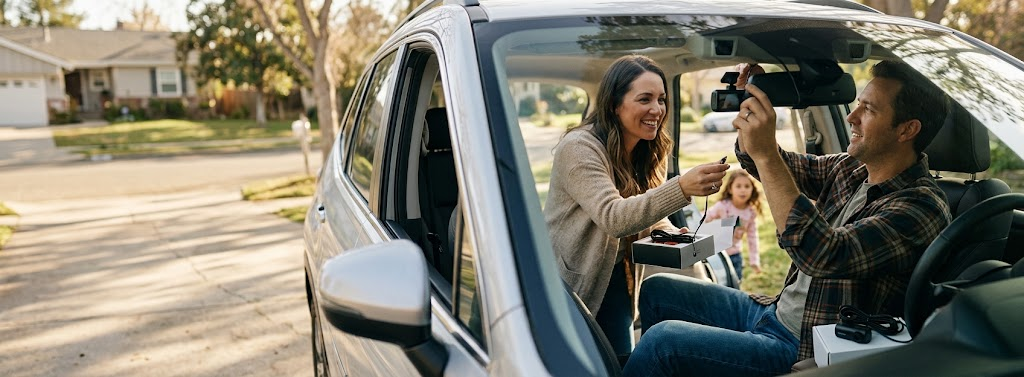
    Tucking the cables behind the weatherstripping and headliner takes about two hours with a simple plastic pry tool. Always route the front-to-rear wire behind side curtain airbags rather than across them for safety. If pulling panels is outside your comfort zone, a local auto shop can handle the install in an hour.

  5. 05

    Set your voltage cutoff

    Before closing up the fuse box, configure the low-voltage cutoff switch on your hardwire kit. Setting it to 12.0V or 12.2V ensures the camera shuts down in parking mode before it drains your car battery too low to start. Take a short drive to confirm both front and rear feeds save clean video files.

  6. 06

    Check the card terms before you commit

    Every figure we publish for the Discover it® Cash Back carries the date a person verified it against Discover and a link to where they checked. Intro windows and APRs change without notice, so confirm the current terms before applying.

    See Discover it® Cash Back terms →

Common questions

Why hardwire instead of using the 12V cigarette lighter plug?

Hardwiring hides all cables behind your interior trim and frees up your power outlet for phone charging. It also provides constant power so the camera can record parking lot hit-and-runs while your car is turned off.

Will a hardwired dash cam kill my car battery?

Not if you use a quality hardwire kit with an integrated voltage cutoff switch. The kit cuts power to the camera once your car battery drops below a set voltage threshold, preserving enough juice to start the engine.

Does having a dash cam lower car insurance rates in the US?

Most US insurers do not offer a direct discount just for owning one. However, footage can instantly clear you of fault in a disputed collision, which protects your deductible and prevents costly rate hikes.

Can I install a dual dash cam myself without electrical experience?

Yes, because modern hardwire kits use piggyback fuse taps that slot directly into your existing fuse box without cutting factory wires. As long as you identify an ignition-switched fuse, an always-on fuse, and a bare metal ground bolt, the job is straightforward.